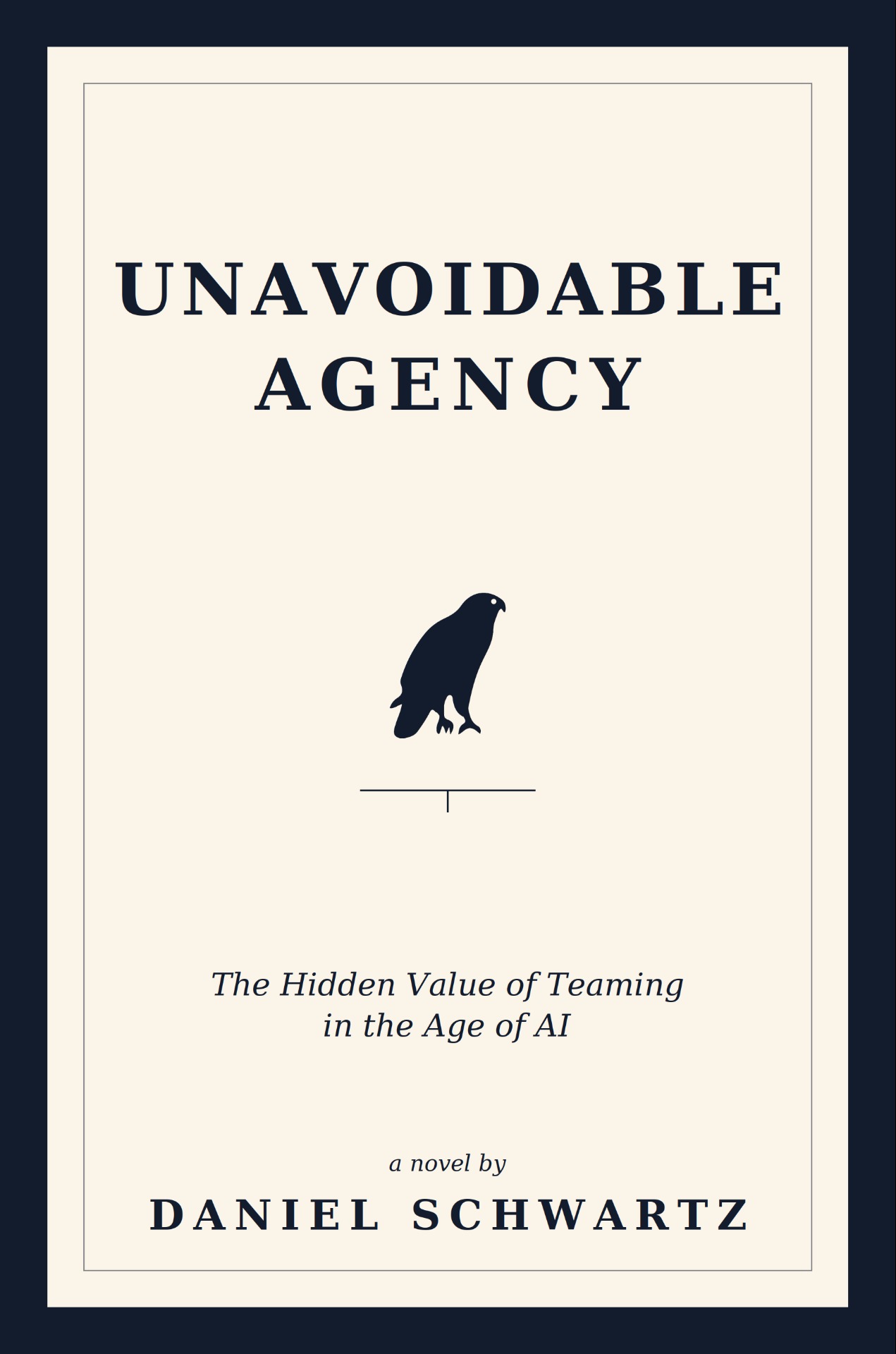
Unavoidable Agency
The Hidden Value of Teaming in the Age of AI
A novel about what happens when you fire two hundred and fifty people who already know how to do their jobs — and what an outside operator and a young COO discover, six months at a time, about the value a company has been producing without knowing it was producing it.
Softcover · ISBN 979-8-234-08964-9
When Sarah Chen, chief operating officer of a mid-market software company called Ardentide, calls Marc Halloran on a Thursday morning in January, she has been told to eliminate two hundred and fifty positions by the end of June. The cuts have already been promised to an activist investor. The justification will be artificial intelligence. The plan will be hers to build.
Marc has spent thirty years inside operating rooms like this one. He has watched companies cut their way to a quarterly target and lose, in the cutting, the people who knew why the company worked. Sarah suspects the same thing. She does not yet know how to prove it.
What follows is a six-month engagement in which Sarah and her three direct reports learn — slowly, and through the work itself — to see the value the company has been quietly producing without knowing it was producing it. Unavoidable Agency is a novel about teams, about the kind of attention real work requires, and about what it means to be useful to other people in the long run.
“The numbers in here describe a company I do not recognize. Either the numbers are wrong or my recognizing is wrong. Most of the time, in my experience, the numbers are wrong. Some of the time, the recognizing is wrong. The work is to know which is which.”
Read the first chapter
Drop your email below and I will send you the first chapter as a PDF, along with the very occasional newsletter.
The call came on a Thursday in early January. I remember because I'd just put the heating on in the upstairs office for the first time that winter and the radiators were ticking, the way old radiators do when they're working out whether they still know how to be radiators.
I didn't recognize the number. I almost let it ring out.
“Mr. Halloran.” Not a question. “I got your name from Anders Wexler. He said you might be willing to talk.”
— continues in the PDF excerpt.
“I have been the COO being asked to execute this playbook. I have not had the language to push back — until now. Read it before your next board meeting.”
“The chapter on senior engineers spending twenty-eight percent of their week reviewing AI-generated code instead of mentoring juniors is the most accurate description of my organization I have read anywhere. We are growing fluent output and starving the judgment that made the fluency worth anything. [Author] has named what my team has been trying to say for two years.”
“Goldratt did it for manufacturing constraints. Komisar did it for venture-stage purpose. [Author] has done it for the age of AI. A serious work of organizational thought disguised as a novel — which is the only form in which most operating leaders will actually read it.”
“I build the kind of AI tools this book is, in some sense, an argument against — and I think every leader deploying them should read it. The case is not that AI is bad. The case is that the value of AI depends entirely on the team wielding it, and most companies are systematically removing the people whose judgment makes the tools worth anything. We are not going to be able to argue with this.”
“Quiet, exact, and devastating. [Author] writes prose with the patience of mid-career le Carré and uses it to mount the most rigorous argument against the AI-justified layoff cycle I have read anywhere. The Caleb subplot alone will outlast a hundred LinkedIn essays on the same subject.”
“I sit on four boards. I have watched, at three of them, exactly the dynamic this book describes: an activist arrives, the cost-cutting math gets done in a way that ignores everything that matters, and a year later the customer relationships are gone. The Unknown Paradox is the first thing I have read that gives directors a framework for asking the right questions in the boardroom while there is still time to ask them.”
“The lineage from McChrystal's task force to a mid-market COO's Monday meeting is not obvious. [Author] makes it obvious. The four practices at the center of this book — Mission, Completion, Contribution, Operating Rhythm — are the cleanest articulation I have encountered of what teaming actually is, once you strip away the slogans. I will be using it with clients for the next decade.”
“I ran a manufacturing company for twenty-eight years. I have read every book in the Goldratt tradition and most of what came after. This one belongs on the shelf with them. The setting is software; the argument is universal. Anyone responsible for an enterprise of skilled humans should read it, regardless of industry.”
Where to buy
Bookshop.org purchases support independent bookstores.
Discussion guide
A short PDF with ten discussion questions, organized by chapter arc, designed for a ninety-minute team conversation. Free for any reader.
Request the Guide →For your whole company
Buying twenty-five or more copies for a team, offsite, or company-wide read? I am happy to record a short video introduction or join a live Q&A.
Inquire About Bulk →